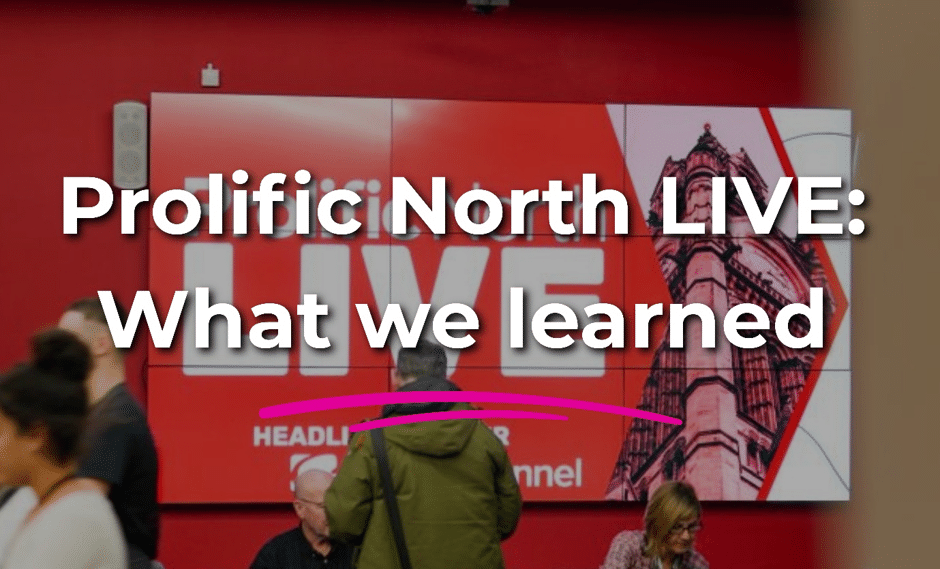
Yesterday, we headed to Prolific North LIVE to hear from leading industry experts who explored and shared their ideas on some of the biggest changes shaping the marketing and communications industry.
The main theme of the day was unquestionable: AI isn’t just a time-saving tool, it’s a tool that is going to play a pivotal part in how Marketing teams operate and shape the industry over the coming years.
A shift towards zero-click marketing was also an interesting discussion as more and more consumers are looking to AI for a purchasing decisions, including Generative Engine Optimisation (GEO) and AI Engine Optimisation (AIEO).
Both of these subjects highlight just how quickly the marketing landscape is evolving, but they also reinforce an important point: while technology is changing how we work, human expertise remains essential.
Here are our biggest takeaways from the event:
1. AI in marketing: Enhance your team, don’t replace it
It’s no surprise that AI was a major talking point at Prolific North LIVE. From improving efficiency to changing how marketing teams operate, its influence is becoming increasingly difficult to ignore.
One of the biggest takeaways was that AI should be used to augment marketing teams, not replace them.
AI is an incredibly useful time-saving tool. It can help businesses streamline processes, analyse information and take care of repetitive tasks, freeing up people to focus on more strategic and creative work.
However, the human element is still vital. AI can generate ideas and content, but it doesn’t replace the experience, judgement, creativity, nuance, and understanding that real people bring to marketing.
This is particularly important when considering how businesses can stand out. If everyone has access to the same AI tools, what makes one brand different from another?
The answer lies in the human input of each business. Original thinking, strong ideas and informed decision-making are what turn AI-generated output into something meaningful.
AI presents an opportunity for SMEs
Another interesting point was the advantage smaller businesses can have when adopting AI.
SMEs often have the flexibility to make decisions and implement changes much quicker than larger enterprises. With AI helping to enhance their capabilities, smaller teams can potentially achieve more without needing to significantly increase their resources.
The key is to integrate AI into everyday workflows rather than treating it as a separate tool or an occasional experiment.
Ultimately, businesses need to understand what AI does best and where human expertise adds the most value. Let the machines do what they do best, and let people do the same.
2. Zero-click marketing: Why GEO and AIEO matter
Another major talking point was the rise of zero-click marketing and what it means for the future of search.
Traditionally, businesses have focused on getting their websites to rank highly on Google, encouraging users to click through and explore their content – but search behaviour is changing.
More people are turning to AI platforms for answers rather than relying solely on traditional search engines. Instead of browsing several websites, users can now ask a question and receive a direct response generated by AI.
This creates a new challenge for brands: how do you make sure your business is included in those answers, even when users never visit your website?
This is where GEO (Generative Engine Optimisation) and AIEO (AI Engine Optimisation) come in.
Both focus on improving a brand’s visibility within AI-generated answers and recommendations. While traditional SEO remains important, businesses also need to think about how AI systems discover, understand and reference their content.
Turn brand claims into evidence
One of the most valuable insights was that brands need to give AI something concrete to work with.
Simply claiming to be the best, most innovative or most experienced in your industry isn’t enough. These statements need to be supported by evidence that AI can understand and potentially reference.
This means creating content that includes:
- Facts and figures: Back up claims with statistics, measurable results and relevant data.
- Comparison tables: Make it easy to understand how your products, services or approach compare with alternatives.
- Original research: Publish findings, surveys and insights that offer something new to the conversation.
- Demonstrable performance: Share case studies, results and examples that prove what your business can deliver.
- Honest comparisons: Explain the benefits and trade-offs of different approaches rather than simply promoting your own offering.
The aim is to create content that is genuinely useful, credible and worth citing.
For businesses, this means moving beyond content that simply promotes their services and towards content that demonstrates their knowledge and expertise.
3. Quality content still matters, but the approach is changing
While AI and zero-click marketing might feel like a significant departure from traditional marketing, one thing remains consistent: good content matters.
However, businesses need to think more carefully about what they’re publishing and why.
Producing large volumes of generic content is unlikely to help a brand stand out, particularly when AI can generate similar material in seconds.
Instead, the focus should be on creating original, evidence-led content that answers real questions and provides genuine value.
For PR and marketing teams, this presents an opportunity. Thought leadership, original research, expert commentary and strong case studies can all help establish credibility and give AI platforms useful information to reference.
It also reinforces the importance of having a clear brand voice and a distinct point of view. Technology can help distribute and optimise content, but the ideas behind it still need to come from somewhere.
What does this mean for businesses?
Our biggest takeaway from Prolific North LIVE is that marketing isn’t standing still.
AI is changing how teams work, while evolving search habits are changing how audiences discover brands. Businesses that adapt to these changes will be better placed to maintain visibility, connect with their audiences and stay competitive.
But embracing new technology doesn’t mean losing sight of what makes marketing effective in the first place.
Human creativity, strategic thinking, original ideas and credible communication are just as important as ever. In fact, as AI becomes more widely used, these qualities could become even more valuable.
For businesses, the challenge is finding the right balance: using AI to work smarter while continuing to invest in the people, expertise and ideas that make their brand different.
A big thank you to everyone involved in Prolific North LIVE for an insightful day. We’re heading away with plenty to think about and some interesting ideas to put into practice!