 " />
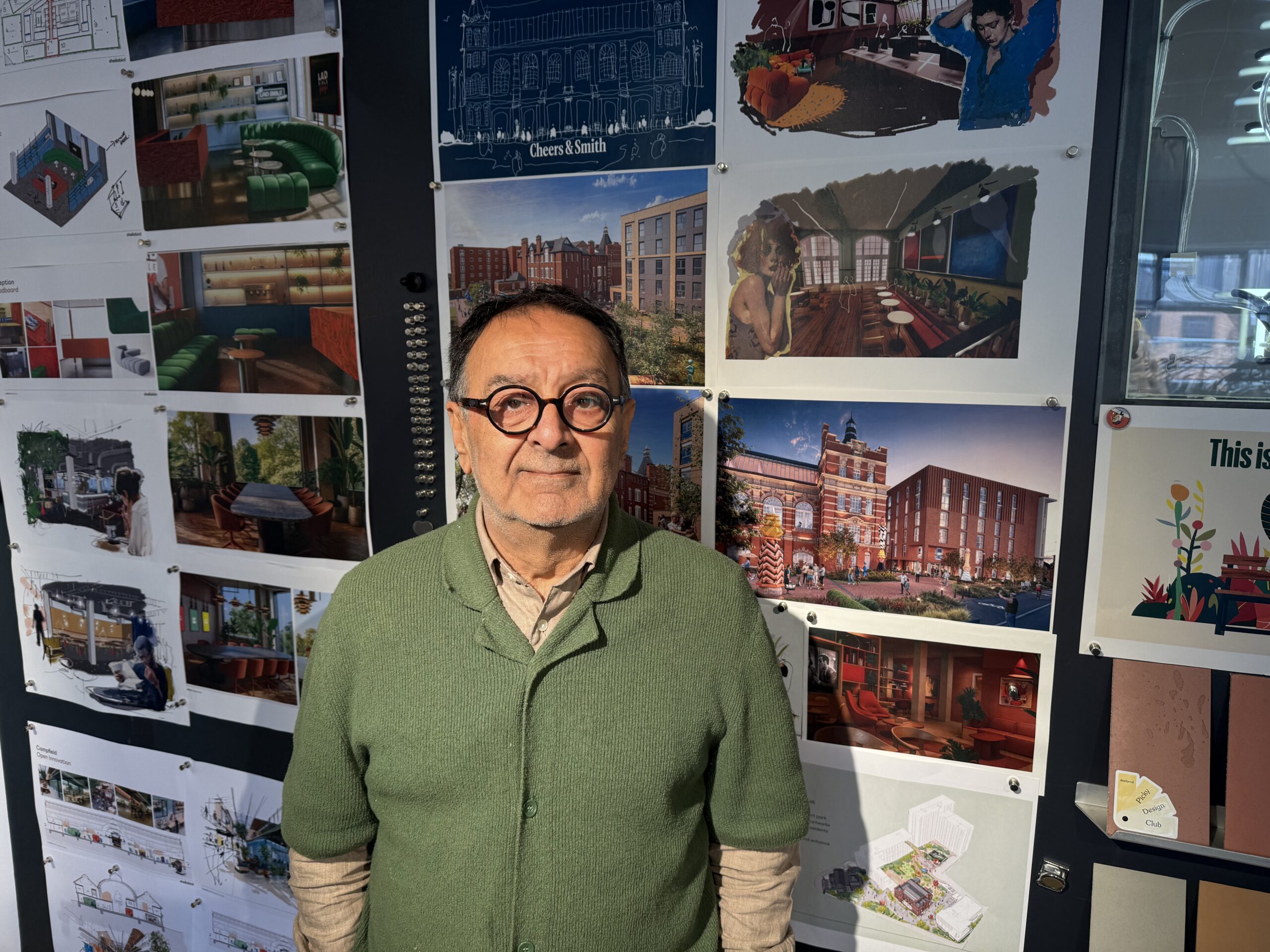
" />In his own words, Atul Bansal is one of the founders and partners of Sheila Bird Studios, is “a creator of spaces that celebrate everything that we love”.
We spoke to Atul to get his perspective on the built environment and how he works with suppliers, partners, and stakeholders to deliver the outstanding work his studio delivers.
Atul has worked in the industry for more than three decades, he and his team are currently working on projects including Steven Bartlett’s new steven.com office which features a 30ft rocket, LADBible’s new London headquarters, and phase two of its work at Campfield, a large workspace designed for creative, digital, media and tech industries in the heart of the St. John’s district.
What’s shaping your outlook on the built environment over the next 12 months?
That’s a big question. The built environment shapes how we live. You have people currently orbiting the Earth in Artemis II – we are a blue and green beacon in the universe. And we’re the only beacon out there that we know of, currently. So, we only have one built environment, and we have to look after it. Everything we do must be focused on the environment and what effect it has on the planet.
How do we shape that – don’t do things that are bad. Instinctively, we know what is wrong. Doing things in a cheap way and cutting corners is bad, and the only people who will suffer from it are our children and us. We have a huge responsibility, and that has to be embedded in everything we do as a collective and as a studio.
We try to make sure everything we do is done in a thoughtful way that reflects the environment we live in. We then take the client on that journey so they can understand it too. It is a joy to do and is really important.
What feels different about the projects you’re working on now compared to even a year or two ago?
Our outlook has always started with the regulations around the built environment and how we can work within them. The older you get you realise the regulations aren’t appropriate and don’t go far enough. You try to stretch it and try to go further, and that can result in resistance from clients. But it’s down to us to go that extra mile and push the boundaries of what is possible.
What makes a manufacturer or supplier stand out when you’re specifying products?
It would be unfair to pick one out. We only work with brands that support our way of thinking, so they’re all brilliant. We don’t populate our suppliers panel and materials library with brands that don’t support the way we think.
We work with suppliers that share our view on sustainability, not those that greenwash. E.g. What do brands do with products at the end of their life? One of the flooring brands we use processes and recycles old and unused materials. That’s just one example, but those sorts of things are really important to us.
Building product manufacturers visit our space and often do workshops with the team to better understand the products and how they can be used.
What excites you most about the future of your work?
What excites me the most is not knowing what we’re going to be doing next. One day, we get a phone call asking if we can do a project, and even though we’ve never done it before, it doesn’t mean we can’t do it. There’s such a variety in what we do.
No week is the same as the previous week, no year is the same as the previous year, and we don’t know where we’re going to end up on a project until we start. And that’s fantastic. You get a brief from a client, and then that conversation produces something that physically exists on a piece of paper, and then the work starts on-site, and somebody builds it, and that is what’s awesome. It’s this discovery, and sense of discovery, that excites me every single day.
How do you make sure a space reflects an organisation’s identity and improves how they work?
We’ve been doing this for 35 years now, and we’ve got a reputation for doing innovative things. People come to us with a problem, and half of the time, they think the problem is because they’ve not got something fit for purpose, or it’s not cool, and they want something different. But nine times out of 10, they don’t know what they want, they just know what they have doesn’t work.
Our job is to find out what they need, not what they want. We start off by exploring their brief and why they’re asking for those things. Is there something deeper within that organisation that we need to understand and take them through a journey with us, to a point where they’re asking and answering their own questions, and then they all, all of a sudden, the penny drops. That is why we interrogate a brief.
The time that an oversized pink table was the answer
An example of this is a job we did a long, long time ago for somebody who said, I’ve got a real problem with the business – nobody is happy, and nobody is talking to each other – can you come in and do something for us? Do something that makes them all happy, make it trendy, or whatever.
We spoke about putting in a pool table. If that was the answer, he didn’t need us, he could just go and buy one. Once we understood the business and the perceived problem, we discovered that, in fact, everybody in that business was not sad or not smiling, it was that nobody was talking to each other in any way, shape or form.
Our solution was to install a huge pink table in the middle of the office. This was an area where people could gather, eat lunch, and communicate in between tasks. It genuinely turned morale and culture around. That is quite a small and simple example of the work we do.
Not just creating a space but influencing behaviour
As a business, we’ve changed. We’re now creating spaces that people want to be in, and that don’t necessarily need to be an interior. It can be outside of a building. It can be a mixture of two things. So, the spaces that we occupy are transient, and they have to evolve. They have to change from the morning to the afternoon to the evening, and when, you know, nobody wants to be at work on a Monday, so you need to make sure the space is super happy on a Monday, but it’s also happy in a different way on Friday. And that’s our challenge.
It also used to be that we created a finished space, but that won’t do anymore. It has to evolve. We use lighting, sound, smells – all sorts of things. This gives people the ability to work and share ideas in different types of spaces, not just sat at a desk.
The whole idea of how we work has completely changed since COVID. Our collective mentality has changed.
Has the return to the workplace since COVID changed how people view your work?
The way we work isn’t a recent way of thinking for us, it’s always been that way. We’ve always challenged the normal way of doing things, because half the time ‘normal’ doesn’t work. Instead, you have to create a variety of ways of communicating within a structure, or a business, or a community, and you have to do that by looking at what that business, or that community, needs. It isn’t the same for everyone.
COVID and the pandemic have actually made our work easier because people are now suddenly realising that actually, I can’t say no to the creative idea, we have to invest in where we work.
When the pandemic happened, there were two or three projects that we were told would never work by the client. Since then, those two or three clients have come back and said they’re ready to go with our ideas. It gave many people a new perspective. So, COVID actually helped the world in lots of different ways.
How important is it for designers to be able to tell a story with their work?
You can be the most amazing designer, but if you can’t communicate it, none of your work or ideas will be shared or commissioned. In the same way, you can be the world’s worst designer, but the most amazing communicator, or full of stories, and you’ll succeed.
So, I think communication, storytelling, and explaining your idea in a way that people can understand it are important. That’s also part of the challenge with some of the rules and regulations, compliance isn’t wrapped around beautiful storytelling. Instead, you have to read them three or four times to understand what they actually mean. So, I think the art of communication is something that we could all benefit from.
One planet – use it wisely
As designers, it’s our responsibility to protect society, along with the regulations. Going back to what I said about our green and blue world – we’ve only got one planet, and we need to do what we can to make it the best space possible.
- Share this