 " />
" />There’s no shortage of ambition in the built environment. Bold masterplans, reimagined districts, and landscape-led visions are reshaping our towns and cities at pace. We’ve got a front row seat to much of this development from our office in Central Manchester.
But amid all the momentum, the following questions are becoming harder to ignore: what happens after the ribbon is cut? Who is the guardian of that place in the decades to come?
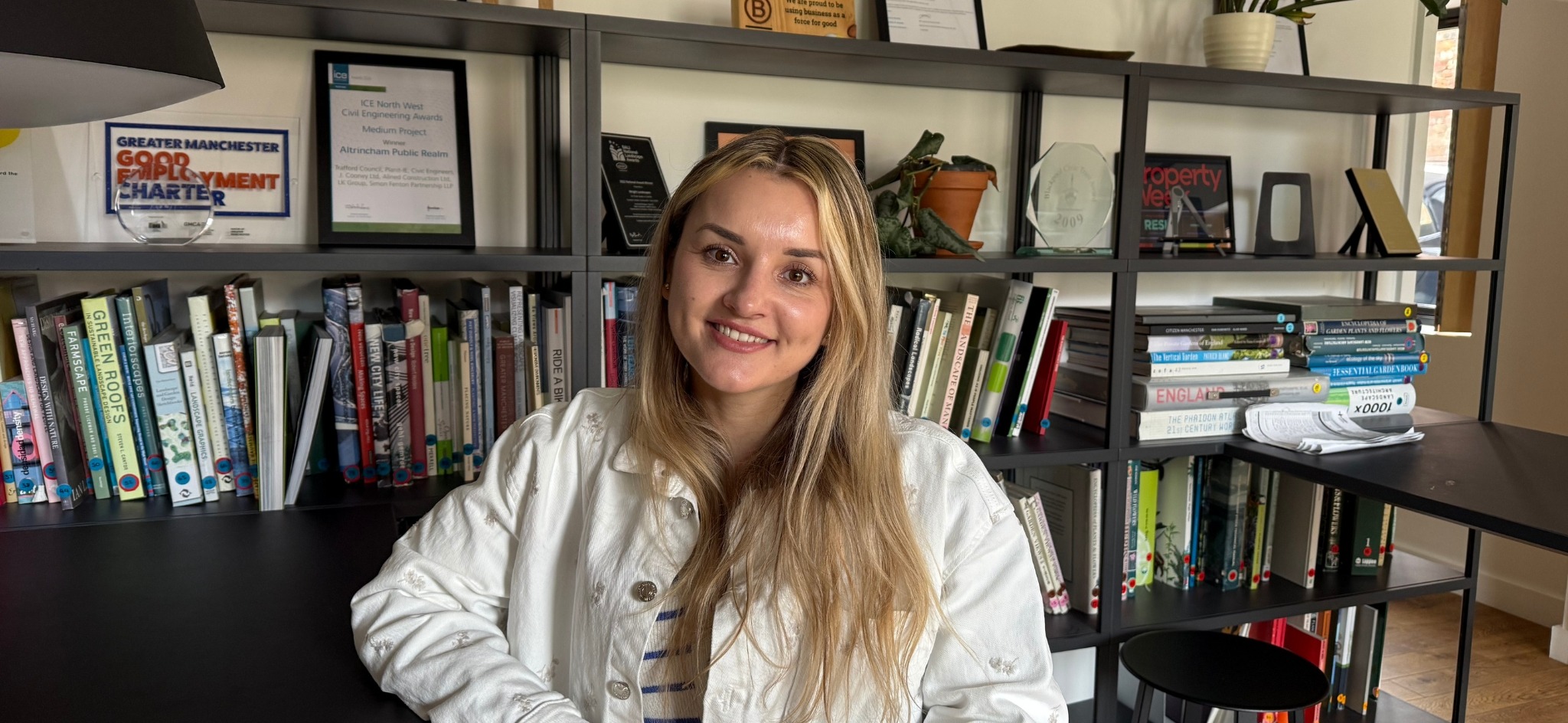
Catalina Ionita, Urban Design Studio Director at Planit, is a self-confessed “fringe thinker”. She sees her place at the intersection of various disciplines rather than a single role.
Cat’s background spans architecture, urban design, research and teaching. She also had an early grounding in the arts in her home country of Romania. She thrives on the cross-pollination of ideas, using inspiration from one area to guide her thinking in another area.
It is this mindset that underpins her approach to design, collaboration and problem solving.
“Having multiple jobs helps keep my brain fresh. After teaching on a Thursday, my mind will often be racing with new ideas to implement and move forward on Friday.”
Beyond the big reveal – what happens to a place long-term
Placemaking has become a defining narrative across the industry. It’s how schemes are sold, visualised and brought to life. But Cat is clear that “creating a place is only part of the story”.
“We talk a lot about placemaking, but not enough about what happens next. Who looks after it for future generations? How does it evolve?”
It’s a challenge that cuts across sectors. From city centre regeneration to mixed-use neighbourhoods, success is often measured at completion, not in the years that follow. Yet the real test of a place is its ability to adapt, endure and remain relevant in the many years that follow.
Designing outside of the red line and incorporating cyan lines
Part of the issue is in how projects are defined. Traditional architectural thinking often stops at the red line boundary, focusing on buildings as standalone objects. But the lived experience of a place sits far beyond that.
“You can design a beautiful building, but if it doesn’t connect to its surroundings, it could be anywhere.”
Cat’s move into urban design reflects a broader shift in thinking, one that puts public realm, landscape and connectivity at the centre of decision-making.
In cities like Manchester, where distinct districts continue to emerge, the opportunity now is to join the dots, creating networks of spaces that are safe, inclusive and genuinely usable. This is what CyanLines aims to achieve. The bold plan to link and transform Manchester’s green and blue spaces is a partnership between the initiative’s co-founders, Tom Bloxham MBE CBE, chair, Urban Splash and Pete Swift, CEO, Planit.
Experience is the new anchor for placemaking
Cat also spoke about the evolution of places like Manchester Arndale, which highlights a wider trend. This is a project that she is working on in her role as an Associate Lecturer at Manchester Metropolitan University, where a group of students from Riga, Latvia, are visiting and exhibiting their concepts for the shopping centre and surrounding areas.
The redevelopment of the area can be traced back to the 1996 IRA bombing of Manchester city centre. Since the initial rebuild, the way we live, work and interact with the city centre has changed.
“We’re no longer designing purely for retail or single-use destinations. Instead, people are seeking experience, places that offer culture, interaction and a sense of belonging.”
“That shift is driving the repurposing of traditional retail. Look at what is currently happening to the old Debenhams unit on Market Street. There’s also a greater emphasis on green, open space, something which Manchester lacks. There is also a need for a focus on wellbeing and social value as part of urban design and the public realm.
“But without long-term thinking, even the best schemes risk losing momentum and not fulfilling their entire potential.”
From urban activation to long-term stewardship of places
Cat’s background in what she calls ‘urban activation’ shapes her approach. For her, the goal isn’t to impose ideas onto a place, but to unlock what’s already there.
“It’s about activating and growing from within, not just making something because it looks good.”
That philosophy extends directly into placekeeping. “Successful places require ongoing curation of events, programming, community use, clear stewardship, and responsibility doesn’t end at handover, and the flexibility that spaces can evolve as behaviours change over their long lifespan. Without these, even well-designed environments can stagnate.”
Learning from what works in the built environment
There are strong precedents for getting this right. Cat talked about how she takes inspiration from cities like Freiburg, Germany and Barcelona, Spain, which have demonstrated how long-term thinking can transform quality of life.
These cities have developed a pedestrian-first planning focus and adaptable public spaces.
“What’s more, they shared a willingness to test ideas before committing, involve communities throughout the process and prioritise people over permanence.
“The UK is beginning to embrace this, but there is still room for improvement.”
Designing with people not just for them
At the core of both placemaking and placekeeping is the simple principle of inclusion. Cat’s work places strong emphasis on co-design, and the bringing together of communities, stakeholders and clients from the outset.
“If people feel they’ve shaped a place, they’re more likely to care for it into the future. That sense of ownership is critical. It’s what turns spaces into places and places into communities.”
Bridging education and practice in the ‘real world’
Alongside her professional role, Cat teaches at the Manchester School of Architecture one day per week, where she works closely with students exploring real-world urban challenges.
Her dual perspective gives her a clear view of the industry’s future and the people shaping it.
“Students today are more values-driven than their predecessors. They are also more digitally fluent and eager to embrace AI and emerging tools. They are also more likely to question and challenge outdated norms.”
Just as importantly, they expect the industry to evolve with them.
“We need to learn and unlearn. The way things were done before isn’t always the way forward.”
A shift in our collective mindset
“The future of the built environment isn’t about bigger, faster or more ambitious projects. It’s about more thoughtful ones.
“Our work must consider their impact over decades, not months. Build in flexibility from day one, and every iteration thereafter. All current and future developments should prioritise long-term stewardship alongside the initial vision.”
Based on our discussion, it is clear that ultimately, the success of a place isn’t defined at launch, but by how it lives on and stands the test of time.
Great places aren’t just designed
Placemaking may capture attention, but placekeeping sustains it.
The most impactful projects will be those that think beyond delivery and embed care, adaptability and community into the fabric of a place from the very beginning.
To read a wider array of perspectives from the built environment, visit our Refresh Perspectives campaign page.
To find out how you can be part of our interview series, or how you can connect with other leaders and decision makers in the construction, manufacturing and built environment sectors, contact us today.
- Share this